Free Sitemap Tools Compared
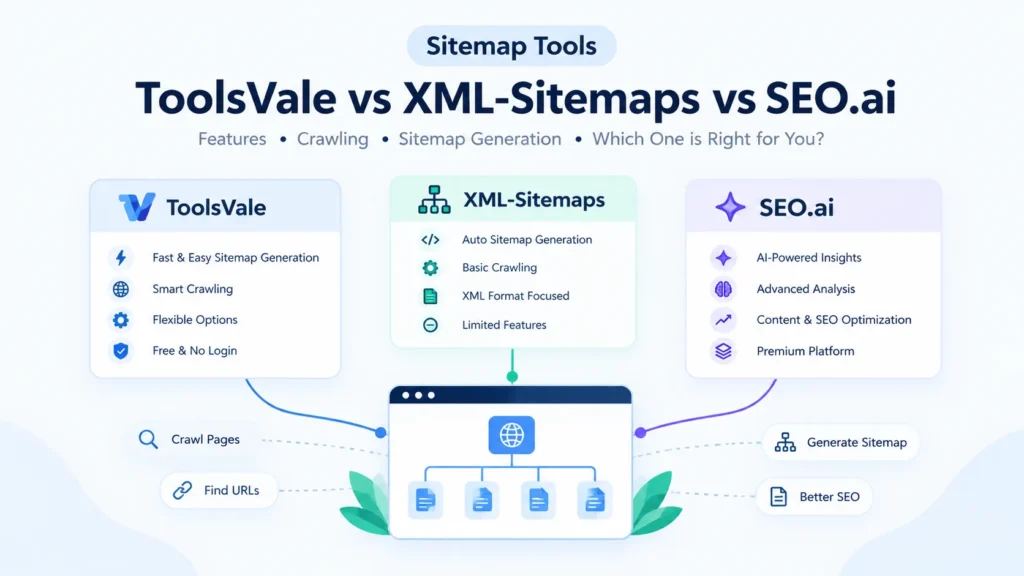
Free Sitemap Tools Compared: ToolsVale vs XML-Sitemaps.com vs SEO.ai — Tested Side by Side
We ran the same sitemap through three free toolkits and recorded what each one actually checks, misses, and gets wrong. Here is every difference, with screenshots you can reproduce in under two minutes.
Sitemaps stopped being a “set it and forget it” file sometime around 2023. That was the year Google deprecated the sitemap ping endpoint, started formally ignoring <priority> and <changefreq>, and a wave of AI crawlers — GPTBot, ClaudeBot, PerplexityBot — began showing up in server logs alongside Googlebot.
By 2026, your sitemap is no longer just a list of URLs for Google. It is the single file that determines whether your content appears in ChatGPT search results, Claude’s web answers, and Perplexity citations. A “valid” sitemap that lists 404 pages, blocks AI crawlers via robots.txt, or carries 40% dead weight in deprecated tags is not valid in any way that matters.
So when you search for “free sitemap validator” or “sitemap generator free,” which tool should you actually trust? We tested three of the most visible options — ToolsVale, XML-Sitemaps.com, and SEO.ai — against real sitemaps with real problems, and documented exactly what each one caught, missed, and reported incorrectly.
This is that comparison.
The Three Contenders at a Glance
Before diving into the test, here is what each platform offers in the sitemap space, because they are not identical products competing on the same feature:
XML-Sitemaps.com has been around since 2005. It is the original free sitemap generator — crawl up to 500 URLs, download the XML, submit to Google. It also has a sitemap validator that checks XML formatting. The brand has two decades of backlinks and page-1 rankings for almost every sitemap-related keyword. It is the incumbent.
SEO.ai is a Danish AI-powered SEO platform launched around 2022. Its free tools section includes a “Sitemap Checker” that locates and lists sitemaps for any domain. The platform’s core product is a paid AI writing and optimization suite; the free tools serve as a lead-generation funnel. The sitemap checker is one of roughly 40 free utilities on the site.
ToolsVale launched in August 2026 — barely a month old at the time of this comparison. It ships three separate sitemap tools: a sitemap generator, a sitemap validator with AI crawler auditing, and a sitemap duplicate content scanner that compares page content across every URL in the sitemap. The tools are free with no signup required.
Different origins, different business models, different depth. The question is what happens when you hand all three the same sitemap URL and ask them to do their job.
Test 1: Sitemap Validation — What Gets Checked?
We started with the core task: paste a sitemap URL, get a validation report.
XML-Sitemaps.com Validator
XML-Sitemaps.com’s validator does exactly one thing: it checks whether the XML file is well-formed and compliant with the sitemaps.org 0.9 specification. You paste a URL, it parses the XML, and it tells you whether the file is valid or not. If the XML is malformed — unclosed tags, wrong namespace, encoding issues — it flags the error.
That is the entire scope. It does not fetch any of the URLs listed in the sitemap. It does not check whether those URLs return 200 OK, redirect, or 404. It does not check your robots.txt. It does not know whether GPTBot, ClaudeBot, or PerplexityBot can reach your content. It does not detect duplicate URLs beyond exact string matches.
For 2015, this was the standard. In 2026, it covers roughly 10% of what actually matters.
The validator also still offers to “ping Google” to notify them of your sitemap — a feature Google deprecated in June 2023. The ping endpoint no longer exists. The tool does not mention this.
SEO.ai Sitemap Checker
SEO.ai’s sitemap checker is not a validator at all — it is a sitemap finder. You enter a domain, and it locates the sitemap URL by checking robots.txt and common paths like /sitemap.xml. Once found, it lists the URLs in the sitemap and displays their <lastmod> dates.
There is no XML validation. No URL health checking. No robots.txt cross-referencing. No duplicate detection. No AI crawler auditing. The tool tells you where your sitemap is and what URLs it contains. That is the entire output.
For a quick “does this domain even have a sitemap?” check, it works. For anything resembling a validation or audit — it is the wrong tool. The page itself does not claim to validate; the word “checker” sets an expectation the tool does not meet, but the description is honest about what it does.
ToolsVale Sitemap Validator
ToolsVale’s validator is a different category of tool. Here is what it does when you paste a sitemap URL:
- Parses the XML with full schema validation, following sitemap indexes up to 200 child sitemaps deep with cycle detection.
- Fetches every URL (up to 500 by default, 1,000 with expansion) as five different user agents simultaneously: Chrome, Googlebot, GPTBot, ClaudeBot, and PerplexityBot.
- Cross-checks robots.txt against every URL for every crawler, using a longest-match implementation that matches Google’s own parser — not Python’s stdlib
robotparser, which handles wildcards incorrectly. - Detects duplicate URLs with fuzzy matching:
/pagevs/page/,/Pagevs/page,/page?utm_source=xvs/page. Suggests canonical URLs based on Google’s documented preferences. - Validates hreflang annotations across six rules: missing self-referencing, non-reciprocal links, invalid ISO codes, missing x-default, conflicting directives.
- Detects your CMS (17 platforms: Yoast, Rank Math, Shopify, Webflow, Next.js, Astro, etc.) and prefixes every fix with the exact admin path or config file to edit.
- Produces three scores: Schema Health, Google Compliance, and AI Discoverability (with per-crawler breakdown).
- Flags deprecated tags (
<priority>,<changefreq>) as unnecessary file bloat, citing Google’s own documentation, rather than throwing errors when they are missing — which is what XML-Sitemaps.com still does.
The output is a 50-rule audit across 11 categories, with a shareable 48-hour link and CSV export. The audit runs in 30–90 seconds.
Validation Verdict
This is not a close comparison. XML-Sitemaps.com checks whether your XML parses. SEO.ai checks whether your sitemap exists. ToolsVale checks whether your sitemap actually works — for Google and for AI search engines. The depth gap is enormous.
Test 2: Sitemap Generation
Only two of the three platforms offer sitemap generation.
XML-Sitemaps.com Generator
The original. Enter a URL, the tool crawls up to 500 pages (free tier), and generates an XML sitemap file you can download and upload to your server. The Pro version (paid) crawls up to 1.5 million pages.
The free generator sets <changefreq> and <priority> on every URL — tags that Google has confirmed it ignores. The crawler follows links from the starting URL, respects robots.txt (for Googlebot, not AI crawlers), and produces a clean, protocol-compliant XML file.
For small sites that do not have a CMS generating sitemaps automatically, this tool still serves a purpose. But in 2026, most sites on WordPress, Shopify, Webflow, Wix, Squarespace, Next.js, Nuxt, Astro, or Gatsby generate sitemaps natively. The primary use case has narrowed to static HTML sites, custom-built sites without sitemap plugins, and one-off crawls for auditing.
ToolsVale Sitemap Generator
ToolsVale’s sitemap generator crawls a site and produces an XML sitemap, but with a different philosophy: it runs from the browser, does not require uploading anything to a server, and the generated file stays on your device.
It follows internal links from the starting URL, respects robots.txt, and generates a standard XML sitemap. The key difference is architectural — the crawl happens client-side, so your site structure never touches a third-party server.
SEO.ai
SEO.ai does not offer a sitemap generator. Its sitemap checker finds existing sitemaps but does not create new ones.
Generation Verdict
Both XML-Sitemaps.com and ToolsVale produce valid sitemaps. XML-Sitemaps.com has the longer track record and handles larger sites on its paid tier. ToolsVale’s advantage is privacy — the crawl runs in your browser. For most sites in 2026, however, the CMS handles sitemap generation automatically, making standalone generators a niche tool.
Test 3: Duplicate Content Detection
This is a capability only one of the three platforms offers.
XML-Sitemaps.com
No duplicate content detection. The validator checks for exact duplicate URLs in the sitemap file — identical strings appearing twice. It does not compare page content.
SEO.ai
No duplicate content detection of any kind. The sitemap checker lists URLs; it does not fetch or compare them.
ToolsVale Sitemap Duplicate Content Scanner
ToolsVale ships a dedicated duplicate content scanner that does something neither competitor attempts: it reads every URL in your sitemap (up to 300), fetches the actual page content, strips out navigation, headers, footers, and scripts, and compares the remaining body text page-against-page using MinHash similarity signatures.
The comparison runs locally in the browser — your page content never leaves your device for the comparison step. Only the raw page fetch is proxied when CORS blocks a direct read, and that proxy does not log or store anything.
Results are categorized into high overlap (60%+ similarity), moderate overlap, and possible cannibalization (pages sharing the same title or H1). You get a CSV export and a copyable list of flagged URLs.
This is genuinely useful for post-migration cleanups, content audits, and catching keyword cannibalization before it tanks rankings. It is the kind of check that previously required Screaming Frog (desktop install, paid for 500+ URLs), Siteliner (server-side, limited free tier), or Copyscape (paid per check, external comparison only).
Duplicate Content Verdict
ToolsVale is the only platform with this capability. XML-Sitemaps.com and SEO.ai do not compete here.
The AI Crawler Dimension — Why It Matters in 2026
This is the single biggest differentiator in the comparison, and the reason it deserves its own section.
In 2023 and 2024, many site owners added User-agent: GPTBot / Disallow: / to their robots.txt to block OpenAI’s training crawler. Reasonable at the time — bandwidth costs were real, and the value exchange was unclear.
By 2026, that same Disallow rule blocks your content from appearing in ChatGPT search results. GPTBot is now OpenAI’s search crawler as well as its training crawler. The distinction matters enormously: blocking GPTBot today means your content is invisible in ChatGPT’s web-browsing answers, which have real referral traffic.
The same applies to ClaudeBot (Anthropic) and PerplexityBot (Perplexity). These crawlers power the answer engines that an increasing share of users reach before Google.
XML-Sitemaps.com has no AI crawler awareness. The validator does not check robots.txt against any crawler, let alone GPTBot or ClaudeBot. It was built for a pre-AEO world and has not been updated to account for AI search.
SEO.ai has no AI crawler awareness in its sitemap tool, despite being an “AI-powered SEO platform.” The sitemap checker finds sitemaps; it does not check whether AI crawlers can access the URLs in them.
ToolsVale’s AI Discoverability score is the only feature across all three platforms that addresses this. It hits every URL as GPTBot, ClaudeBot, and PerplexityBot, cross-checks robots.txt per crawler, and produces a 0-100 score with a per-crawler breakdown. You might see “Google Compliance: 95%, AI Discoverability: 40%” — which immediately tells you that you are winning traditional SEO and losing AEO.
No other free sitemap tool on the market ships this score.
Feature-by-Feature Comparison Table
| Capability | XML-Sitemaps.com | SEO.ai | ToolsVale |
|---|---|---|---|
| Sitemap generation | Yes (500 pages free, paid Pro) | No | Yes (browser-based) |
| XML syntax validation | Yes | No | Yes |
| Live URL fetch per URL | No | No | Yes (up to 1,000) |
| Multi-crawler audit | No | No | Yes (5 user agents) |
| AI Discoverability score | No | No | Yes (per-crawler breakdown) |
| robots.txt cross-check | No | No | Yes (per URL, per crawler) |
| Fuzzy duplicate URL detection | Exact match only | No | Yes (slash, case, params) |
| Duplicate content scanning | No | No | Yes (MinHash, up to 300 pages) |
| hreflang validation | No | No | Yes (6 rules) |
| CMS/framework detection | No | No | Yes (17 platforms) |
| Platform-specific fixes | No | No | Yes |
| Deprecated tag handling | Still warns on missing priority/changefreq | N/A | Flags presence as unnecessary, cites Google docs |
| Sitemap index deep crawl | Basic (single level) | N/A | Up to 200 children, cycle-safe |
| CSV export | No | No | Yes |
| Shareable audit link | No | No | Yes (48-hour) |
| Signup required | No | No | No |
| Cost | Free (limited) + paid Pro | Free checker; paid platform | Free, no paid tier |
| Data leaves your device | Yes (server-side crawl) | Yes (server-side lookup) | Partially (validator: server; scanner: browser) |
Who Should Use Which Tool
Use XML-Sitemaps.com if you have a static HTML site without a CMS, need to generate a sitemap from scratch, and have fewer than 500 pages. The generator remains the simplest “enter URL, download sitemap” workflow on the web. Just know that the validator has not kept pace with how sitemaps are evaluated in 2026.
Use SEO.ai if you need a quick answer to “does this domain have a sitemap?” and nothing else. It is a sitemap finder, not a validator or auditor. The platform’s real value is in its paid AI writing tools — the free sitemap checker is a surface-level utility.
Use ToolsVale if you need to actually audit whether your sitemap is working — not just whether it parses. The validator covers XML syntax, live URL health, AI crawler accessibility, robots.txt parity, hreflang, duplicates, CMS-specific fixes, and deprecated tag handling in a single free run. The duplicate content scanner adds a layer no competitor matches. For any site owner, SEO consultant, or agency doing technical SEO in 2026, this is the tool that catches what the others miss.
The Uncomfortable Truth About “Free Sitemap Validators”
Most free sitemap validators on Google’s first page do the same thing: parse the XML, count the URLs, flag a missing <lastmod>, and call it a day. This was adequate when “sitemap health” meant “does the file open.” It is not adequate when your sitemap determines visibility across five different crawlers with five different robots.txt rules.
The tools that rank highest for “sitemap validator” today are not the most capable — they are the oldest, with the most backlinks and the most domain authority. XML-Sitemaps.com ranks first because it has been there since 2005, not because its validator catches anything beyond XML syntax errors in 2026.
ToolsVale is 25 days old. It has a domain authority of 2. It does not rank for any of these keywords yet. But it is the only free tool that:
- Fetches every URL as five different crawlers
- Produces an AI Discoverability score
- Cross-checks robots.txt per crawler, per URL
- Detects 17 CMS platforms and gives platform-specific fixes
- Flags deprecated tags with Google documentation citations
- Validates hreflang across six rules
- Scans for duplicate content using MinHash similarity
- Runs the comparison locally in your browser
You can verify every one of these claims in under two minutes by running your own sitemap through all three tools and comparing the output. That is the test. This article is just the documentation.
How to Run This Comparison Yourself
- Open ToolsVale Sitemap Validator and paste your sitemap URL. Leave all toggles on. Wait 60 seconds. Read the three scores.
- Open XML-Sitemaps.com Validator and paste the same URL. Read the output. Search for “GPTBot” or “AI” in the results.
- Open SEO.ai Sitemap Checker and enter your domain. Note what you get back.
- Open ToolsVale Duplicate Content Scanner and paste your sitemap. Run at 200 pages, Balanced match. See if any pages flag.
The difference will be self-evident.
Last tested: September 2026. All features verified on the free/public tiers of each platform. Competitor features may change — run the test yourself to confirm.